

Things move fast. The dog races through the tunnel, takes the jumps and finds the next obstacle – dog and handler must stay in contact with each other at all times.
That is one of the things I love about agility.
Although at first glance agility may look like a sport mainly about speed and obstacles, it is at least as much about teamwork. You have to learn to read your dog, and your dog has to learn to understand your commands and signals. When it works, it almost feels as though you are moving around the course as one unit.
And the best thing is that the joy is not found only in competitions or the fastest runs. It is just as much a part of training, when something you have practised for a long time finally comes together.
What is agility?
Agility is a dog sport in which the dog and handler work together to complete a course of various obstacles in the fastest time possible, with as few faults as possible – ideally none.
On the course, the dog may encounter jumps, tunnels and weave poles, as well as contact obstacles such as the A-frame, dog walk and seesaw. Contact obstacles have marked contact zones that the dog must touch on its way over the obstacle. This is to ensure the dog’s safety.
The handler runs alongside the dog and shows it the way through movement, positioning, body language and verbal commands.
This means that the dog must not only be able to tackle each individual obstacle. It must also understand where to go next.
That is precisely what makes agility so fun and challenging: you never really stop learning.
When you watch an experienced dog-and-handler team run a course, it can look both fast and effortless. But behind it lie many hours of practising the finer details – and teamwork built up over time.
How do you get started with agility?
My best advice: quality over quantity. It is better to complete three obstacles perfectly and give a good reward than to attempt 12 obstacles that end in mistakes. Dogs learn from what we get right – not from how many obstacles we manage to complete.
You don’t need to know anything in advance, and your dog certainly doesn’t need to be able to complete an entire agility course from the very first training session.
Find somewhere that offers agility training with a skilled instructor, and start gently and gradually. This is where you and your dog can safely learn the basic skills and become familiar with the individual obstacles.
For me, it’s important that the dog is having fun. Agility should be something we do together – not something the dog is forced through.
That’s why rewards are so important. For some dogs, the best reward is a treat. For others, it’s their favourite toy or a little celebration with their human. The most important thing is to find out what makes your particular dog happy and motivated.
As a newcomer to the sport, you shouldn’t compare yourself too much with the experienced teams. They, too, once stood at their first training session, trying to work out which way they were supposed to run.
Take one thing at a time, enjoy the small improvements, and remember that a good agility run begins long before you step onto a competition course.
“Agility should be something we do together – not something the dog is forced through.”
How do you maintain your agility skills – and get better?
Of course, you improve by training. But not necessarily by simply training more.
One of the most important things I’ve learned is to stay curious about training. Why did it work? Why did it go wrong? Did I give the dog the right signal? Was I too late? Or perhaps did I ask for something the dog hadn’t learned well enough yet?
In agility, it’s very easy to blame the dog for a mistake. But often, the explanation lies with us.
That’s why I work a lot on the small details. It might be a particular turn, an independent obstacle, the weaves, reliable contact behaviour on the contact obstacles, or my own positioning and timing on the course.
Short, productive training sessions can be far more valuable than carrying on until both dog and handler are tired.
And remember that agility is a physically demanding sport. The dog is an athlete, and training must take that into account. Warming up, taking breaks, physical fitness and recovery are also part of the sport. The goal isn’t just to have a fast dog – but a dog that enjoys taking part in the sport and is doing well.
For me, development is therefore not just about shaving seconds off a run. It’s also about getting better at understanding my dog and making our partnership clearer and much stronger.

The 3 quick tips
1. What do you enjoy most about doing agility with your dog?
I love the teamwork. The feeling I get when my dog and I really connect on the course is absolutely fantastic. Of course, I also love the speed and excitement, but the best part for me is seeing my dog’s joy and commitment, and feeling that we are tackling the challenge together.
2. What has been your best experience?
It is actually difficult for me to choose just one particular experience, because I feel that everything is part of what I love about agility: the training, the small and large competitions, and of course the truly major events such as the Nordic Championships, the European Open and the World Championships.
I have had so many wonderful experiences with agility, and for me, the greatest moments are not necessarily just about placings and results. I particularly remember the runs where everything comes together perfectly, and I cross the finish line feeling that my dog and I were truly a team. That is the feeling I take with me – whether it is at training, a small competition or on one of the biggest international courses.
3. What keeps you going and makes you continue doing agility and training with your dog?
I keep going because I never feel that I have finished learning agility. There is always something new I can learn and something my dogs and I can improve together.
I love training with my dogs, developing our teamwork and feeling how we grow stronger as a team. When I can see from my dogs that they are looking forward to training and are ready to get going, that is also what keeps me motivated.
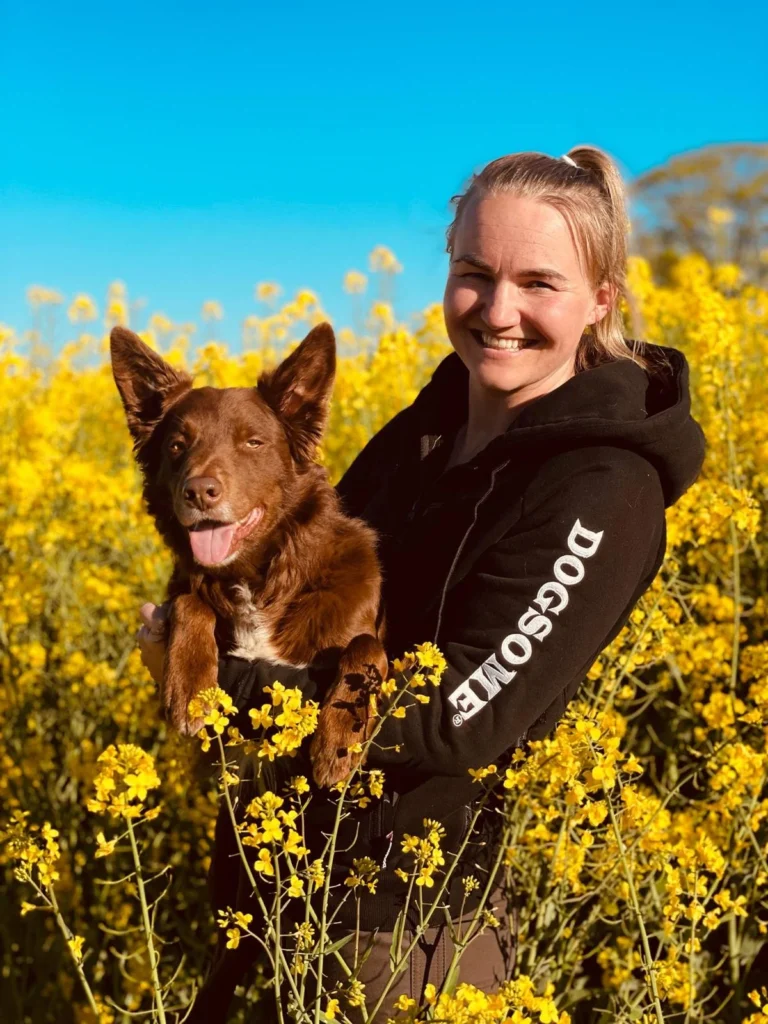
Heidi Simonsen
I have been doing agility for 15 years and now train with eight-year-old Ghost and five-year-old Cap. Over the years, agility has given me many wonderful experiences – from training and competitions here at home to the Nordic Championships, the European Open and the World Championships.
I am also an agility instructor at DKK Vilhelmsborg in Aarhus, where I enjoy passing on my experience and passion for the sport and helping others develop their partnership with their dogs.
For me, agility is first and foremost about the joy of the dogs, the training and the strong partnership we build together.